
Why Data Visibility Matters in High-Risk Industries
Calgary, Canada- January 28,2026 In heavy industries such as oil and gas, mining, metals processing, and petrochemicals, the tolerance for failure is extremely low. Assets operate under harsh conditions, safety risks are constant, and unplanned downtime can lead to significant financial, environmental, and reputational consequences. In these environments, inspections are not optional; they are fundamental to safe, reliable operations.
Over the past decade, inspection technologies have advanced rapidly. Autonomous robots are now capable of collecting vast amounts of visual, thermal, and acoustic data without exposing workers to hazardous conditions. However, while the quality and volume of inspection data have improved, many organizations still struggle to translate that information into timely, confident decisions.
Inspection data is often siloed, manually reviewed, or treated as a one-time snapshot rather than a continuous source of operational insight.
The challenge is no longer how to collect inspection data, but how to make it meaningful. True operational resilience depends on visibility: understanding how assets behave over time, recognizing early warning signs, and acting before issues escalate. Turning inspection data into actionable insight has become a critical capability for industrial operators.
From Inspections to Intelligence: The Role of Data Navigator
Autonomous robotic inspection platforms have transformed how industrial facilities are monitored. Robots can perform routine inspections consistently, access hard-to-reach areas, and operate safely in hazardous environments. Yet inspection alone does not prevent failures; the value lies in how inspection results are interpreted, compared, and acted upon.
This is where tools like ANYbotics’ Data Navigator play a central role. Rather than treating inspection outputs as static reports or disconnected files, Data Navigator provides a structured way to organize, analyze, and contextualize robotic inspection data.
It bridges the gap between field data collection and decision-making for operations, maintenance, and reliability teams.
By consolidating inspection results and presenting them in a clear and accessible format, Data Navigator enables teams to move beyond reactive responses. It supports predictive maintenance and trend-based decision-making, helping organizations detect emerging issues earlier and prioritize interventions more effectively.
In doing so, robotic inspections become not just a technical capability, but a strategic operational tool.
What Data Navigator Is (and Is Not)
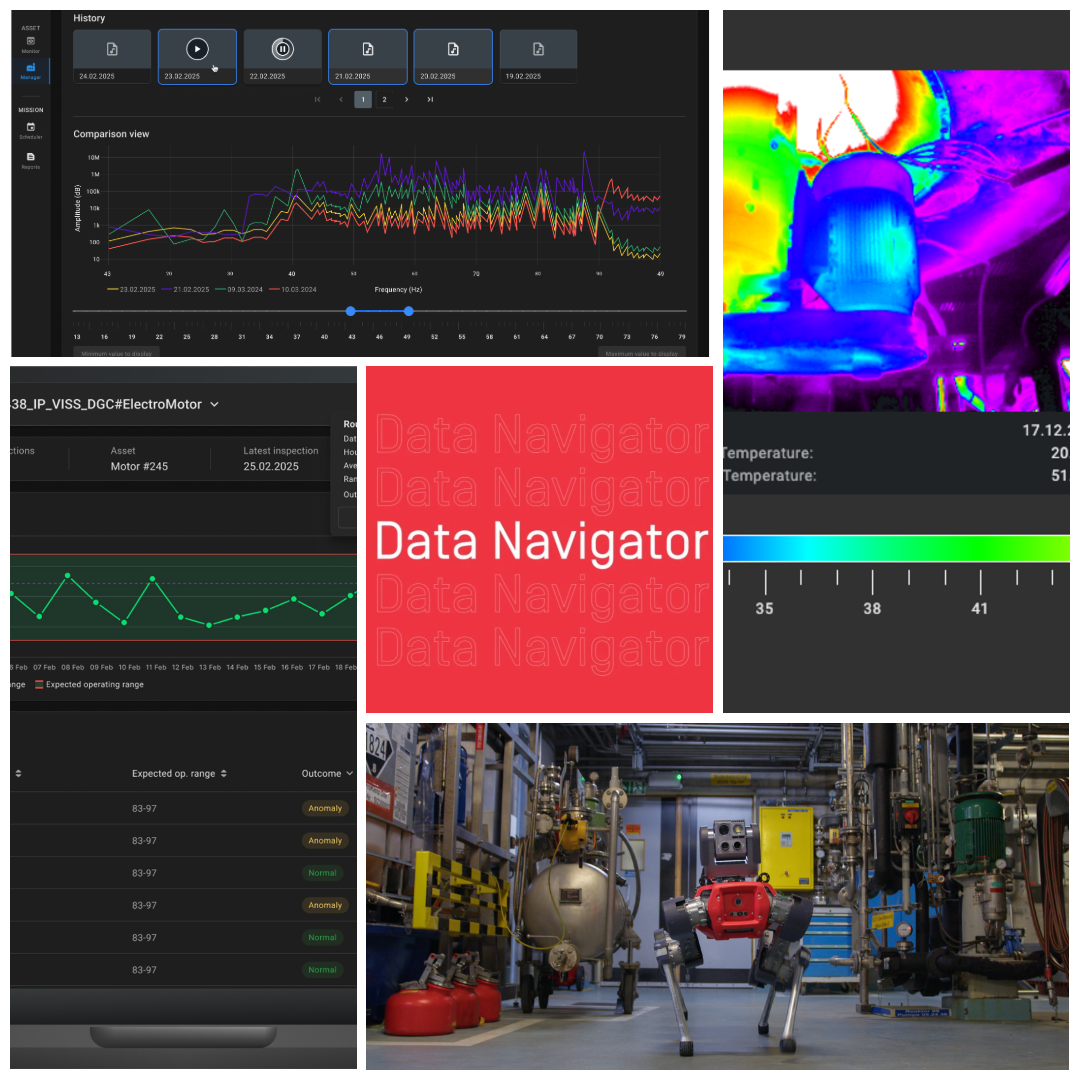
Data Navigator is a centralized inspection data platform designed to work alongside the ANYmal robotic inspection system. It brings together multiple data types — including visual, thermal, and acoustic results — into a single environment where inspection outputs can be reviewed, compared, and tracked over time.
At its core, Data Navigator is built for industrial users. It is designed to be used by operations teams, maintenance professionals, and leadership without requiring deep expertise in robotics or data science.
The platform emphasizes clarity, consistency, and context, allowing users to quickly understand asset condition and identify changes that matter.
Equally important is what Data Navigator is not:
It is not simply a file repository or image viewer
It is not limited to isolated inspections or one-time missions
It does not treat inspection data as static
Instead, it supports longitudinal analysis, enabling teams to see trends, detect anomalies, and build a continuous understanding of asset health as conditions evolve.
By focusing on insight rather than raw data, Data Navigator helps organizations move from collecting information to making informed, defensible decisions.
Core Capabilities of Data Navigator
Data Navigator is designed to transform large volumes of robotic inspection data into clear, usable operational insight. Its key capabilities focus on organization, comparison, and interpretation, enabling teams to understand asset condition without manual data handling or complex analytical workflows.
- Centralized Inspection Data Management
Inspection results from repeated ANYmal missions are stored in a single platform, ensuring consistency across assets and time. This eliminates fragmented datasets and makes it easier to establish reliable inspection baselines.
- Trend Analysis and Historical Comparison
Trend analysis is central to the platform’s value. Data Navigator allows users to compare inspection results across time, making gradual changes visible.
Subtle temperature increases, shifting acoustic signatures, or progressive visual degradation can be identified well before they reach critical thresholds.
- Anomaly Identification and Prioritization
Rather than requiring teams to manually review every data point, Data Navigator highlights deviations from expected conditions. This helps users focus attention on the assets and issues that matter most.
- Operational Oversight of Robotic Inspections
Operators can remotely monitor active missions across multiple ANYmal units in a fleet and intervene when necessary. Missions can also be halted remotely, allowing teams to respond quickly if conditions change during an inspection.
- Inspection Performance Monitoring
Data Navigator tracks inspection and mission success rates, giving teams visibility into how consistently inspections are completed as planned.
This supports continuous improvement by highlighting:
gaps in coverage
recurring mission issues
opportunities to refine inspection routes
Together, these capabilities make Data Navigator more than a data viewer. It becomes a central interface for managing inspections, understanding asset condition, and ensuring robotic inspection programs deliver reliable, repeatable results.

Example Workflow: From Inspection to Action
A typical workflow begins with ANYmal completing an autonomous inspection. A predefined set of points of interest (POIs) is inspected, capturing visual, thermal, and/or acoustic data from critical assets.
Once the inspection is complete, the data is automatically ingested into Data Navigator. Results are organized by asset and compared against historical inspections, with trends and anomalies clearly highlighted.
Operators, engineers, and leadership teams can review the most recent inspection data or examine long-term asset history to identify emerging issues such as:
gradual temperature increases
abnormal sound patterns
visual changes indicating wear or damage
If anomalies are detected, corrective actions can be planned and executed before escalation into failure.
This workflow reduces unplanned downtime, minimizes safety risks, and provides clear documentation to support maintenance decisions.
Safety, Reliability, and Confidence
The ability to interpret inspection data effectively has direct implications for industrial safety and operational reliability. When issues are identified earlier, interventions can be planned and executed before conditions become hazardous. This reduces the likelihood of sudden failures, emergency repairs, and unplanned shutdowns.
Data Navigator also helps keep people out of harm’s way. By supporting remote and autonomous inspections — and enabling data-driven decisions without repeated site visits — it reduces the need for human exposure to high-risk environments. From an operational perspective, consistent and traceable inspection data builds confidence. Maintenance decisions are no longer based solely on intuition or incomplete information, but on documented trends and objective evidence.
This strengthens:
cross-team communication
audit and regulatory compliance
trust in inspection outcomes
Conclusion
Robotic inspections have fundamentally changed how industrial assets can be monitored, especially in environments where safety risks and operational constraints limit human access. However, the value of these inspections depends on more than data collection alone. Without context, comparison, and visibility over time, inspection data remains underutilized. Data Navigator addresses this gap by connecting robotic inspection data to the decisions that drive safety, reliability, and operational performance. By enabling teams to understand asset condition over time, manage inspections across robotic fleets, and measure inspection program effectiveness, it turns inspection data into a practical decision-making tool.
As industrial organizations continue adopting autonomous inspections, platforms that provide clarity, consistency, and confidence will be essential. Data Navigator supports this shift by helping teams move from reactive responses to informed, proactive asset management.